Creating a Culture That Produces Relationship Owners
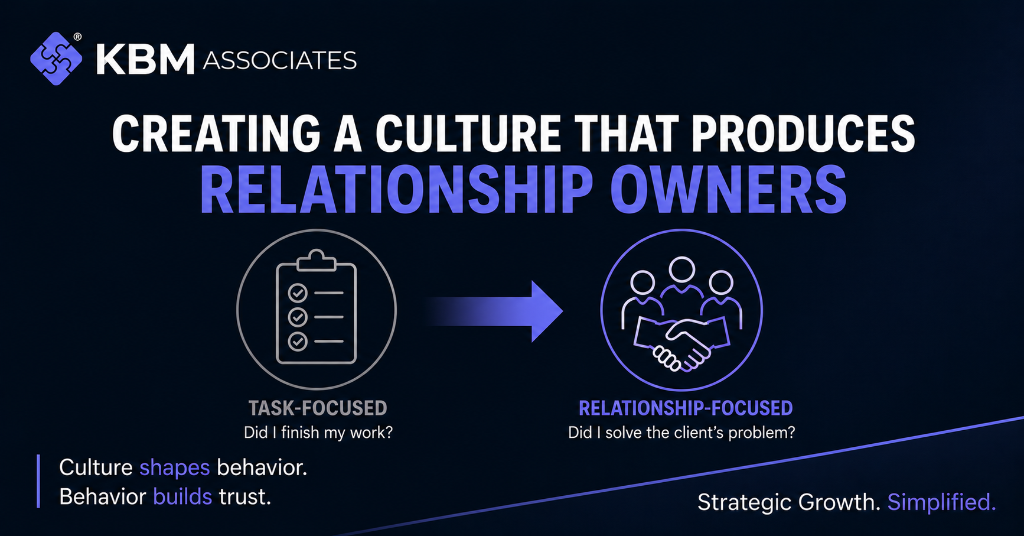
In my previous posts, I argued that clients—not firms—decide who owns the relationship. I also discussed how great client service organizations are intentionally designed so that every employee has the opportunity to earn that trust.
But organizational structure alone isn't enough.
You can provide training, document processes, and empower employees to make decisions, yet still struggle to build meaningful client relationships.
Why?
Because culture ultimately determines behavior.
Culture Determines How Employees Think
Every organization has a culture, whether it's intentional or not.
Some firms create a culture where employees ask:
"Did I finish my work?"
Others create a culture where employees ask:
"Did I solve the client's problem?"
That difference may seem small, but it changes nearly every decision employees make throughout the day.
The first creates task completion.
The second creates trusted advisors.
What Relationship-Based Cultures Reward
Employees naturally repeat the behaviors that are recognized, rewarded, and celebrated.
If your organization praises efficiency above all else, employees will become efficient.
If it praises billable hours above all else, employees will maximize billable hours.
If it praises solving client problems, building trust, collaborating across departments, and taking ownership, those behaviors become part of the organization's identity.
Culture isn't created by mission statements hanging on a wall.
It's created by what leadership consistently rewards.
Relationship Owners Think Differently
Relationship owners don't ask:
"Whose job is this?"
They ask:
"How do we solve this?"
They don't worry about whether an issue belongs to tax, accounting, consulting, payroll, or operations.
They own the client's experience first.
That doesn't mean they solve every technical problem themselves.
It means they own making sure the problem gets solved.
Clients notice that difference.
Leadership Sets the Standard
Building a relationship-based culture begins with leadership.
Leaders must model the behaviors they expect from others.
If leaders refuse to collaborate, employees won't collaborate.
If leaders protect information, employees will protect information.
If leaders compete internally, departments will compete internally.
But when leaders openly support one another, share knowledge freely, remove barriers, and celebrate client success above personal recognition, employees begin to do the same.
Culture is contagious.
Leadership simply determines what spreads.
Trust Begins Inside the Firm
Many firms spend enormous amounts of energy trying to build trust with clients.
Few spend the same amount of energy building trust among employees.
That's a mistake.
Employees who trust one another collaborate more effectively.
They communicate more openly.
They ask for help sooner.
They share knowledge more freely.
And ultimately, they provide a better experience for the client.
External trust is often a reflection of internal trust.
Building a Relationship-Based Firm
Relationship ownership isn't a title.
It isn't assigned during onboarding.
It isn't determined by seniority.
It's earned every time an employee demonstrates ownership, solves a problem, follows through on a commitment, and builds trust.
When enough people consistently do those things, relationship ownership stops belonging to individuals.
It becomes part of the firm's culture.
That's when something remarkable happens.
Clients no longer trust one employee.
They trust the organization.
And that's one of the strongest competitive advantages a client service firm can build.