Building a Firm Where Every Employee Can Own the Relationship
In my previous post, I argued that firms don't decide who owns the client relationship—the client does.
Clients naturally place their trust in the person who consistently solves their problems, communicates well, and follows through. Titles don't determine relationship ownership. Trust does.
That raises an important question.
If clients choose their relationship owner, how should a firm be designed?
Too many client service organizations unintentionally create barriers between clients and the people best equipped to help them. Clients are encouraged to contact the partner, the partner delegates to a manager, the manager assigns the work to a senior, and eventually the question reaches the person who could have solved it from the very beginning.
Every additional handoff costs time, creates frustration, and weakens the client experience.
A truly relationship-based firm operates differently.
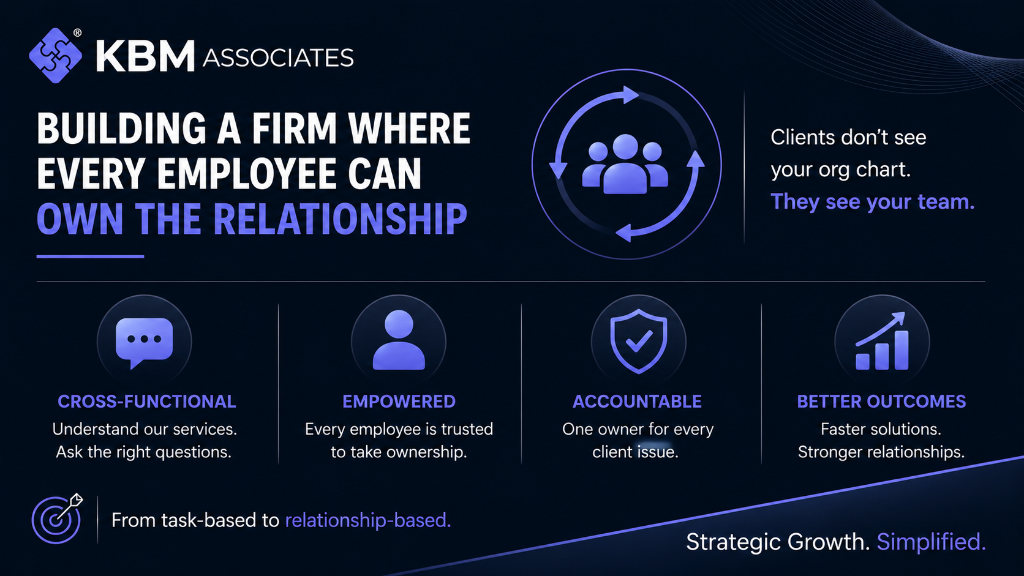
Instead of teaching employees to simply complete assigned tasks, it teaches them to own client problems.
Those are two very different philosophies.
A task-based employee asks:
"How do I complete the work assigned to me?"
A relationship-based employee asks:
"How do I help this client accomplish what they're trying to achieve?"
That shift changes everything.
It changes how employees communicate with clients.
It changes how departments work together.
It changes how success is measured.
Most importantly, it changes how clients experience the firm.
Creating that environment doesn't require every employee to become an expert in every service your firm offers. It requires something far more practical.
Every employee should understand the firm's capabilities well enough to recognize client needs, ask thoughtful questions, and confidently connect clients with the right resources. More importantly, they should never feel comfortable saying, "That's someone else's responsibility."
Every client issue should have an owner, even when multiple people contribute to the solution.
That requires cross-functional awareness, ongoing training, and, perhaps most importantly, trust between employees.
Leaders also have to be willing to let relationships develop naturally.
Many firms unintentionally discourage this by protecting hierarchy. Employees hesitate to engage beyond their assigned responsibilities, while managers become protective of client communication. Yet clients rarely care about organizational charts. They care about getting answers from people they trust.
Great firms don't create bottlenecks around their most senior people.
They build organizations where trust can develop at every level.
When that happens, clients stop relying on one individual and begin trusting the organization itself.
That's the real objective.
In my next post, I'll discuss the most difficult part of building a relationship-based firm: creating an organizational culture that encourages employees to think like relationship owners every day.